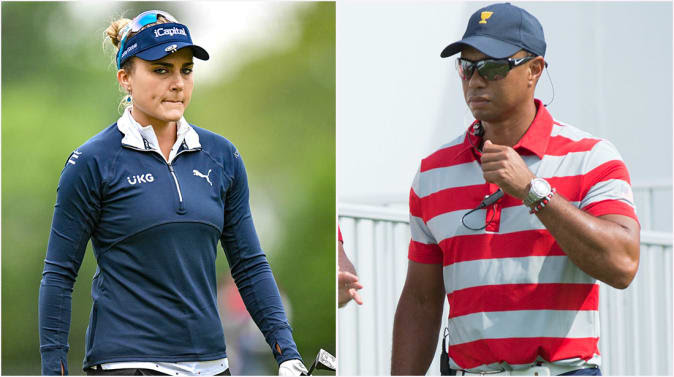
In the ever-evolving world of professional golf, Lexi Thompson’s name has made headlines in 2023 for less-than-flattering reasons. She began as a slumping star, later questioned her eligibility for the U.S. Solheim Cup team, and found herself one of only three American golfers to face Europe three consecutive times without a single victory. Although she did manage to notch a 3–1 record in Spain last month and secure a pair of top-10 finishes on the LPGA Tour, her presence in this week’s PGA Tour event in Las Vegas raises eyebrows. It’s the twelfth time a female golfer has taken on the challenge of competing against men since Annika Sörenstam broke the barrier in 2003.
What’s concerning isn’t a matter of gender; rather, it’s Thompson’s current form that raises questions about her participation in the tournament. The risk and downside seem to outweigh the potential rewards. Thompson’s competitive spirit has endured a tumultuous year, marking her worst season as a professional athlete. After a decade of relative excellence, she now finds herself struggling to regain her previous glory, with the Las Vegas tournament using her name recognition for its own commercial gain.
One cannot help but wonder if this decision is a desperate plea for attention. The PGA Tour’s fall schedule is traditionally meant to provide opportunities for aspiring male golfers looking to solidify their status for the following year. Will Thompson’s presence generate more interest or increase the visibility of this lower-tier event that coincides with the football season? It’s reminiscent of past attempts where historic moments or interesting narratives gave women’s participation a sense of purpose. However, in the case of Lexi Thompson in Las Vegas, the equation may yield diminishing returns, transforming it into a lackluster sideshow.
Some experts even opine that this move might do more harm than good to Thompson, as she’s just beginning to regain her footing in the game. The timing seems perplexing at best.
However, in the broader context of American golf, another thought emerges. When contemplating the recurring disappointments of U.S. Ryder Cup teams, the question arises: why not turn to Captain Tiger Woods? Despite Woods’ less-than-stellar record against Europe, his aura and leadership qualities bring a multitude of advantages. The PGA of America could benefit from these qualities by appointing Tiger as the captain for the next two Ryder Cup squads, with an eye on a long-term commitment.
The one-and-done approach with U.S. captains hasn’t produced the desired results for some time. It’s high time for Woods to assume a more extended leadership role. The longer one ponders this possibility, the more evident it becomes that there’s no other viable candidate. With Tiger at the helm, the issue of financial compensation for players’ participation in the matches would likely fade away, or he would find players more appreciative of the opportunity. Woods has success in his DNA, having led the 2019 Presidents Cup squad to victory despite losing his star player, Brooks Koepka, to injury.
Tiger’s appointment would introduce much-needed consistency to the program, something that eludes most U.S. captains. His iconic status among today’s young stars would provide unwavering motivation. As Davis Love III suggested, the job is Tiger’s if he desires it, and it’s an offer he shouldn’t refuse. For a man of unparalleled greatness, this is a chance to reverse his Ryder Cup legacy and, as a famous political slogan once stated, “Make America Great Again.”
Shifting gears, Alan Shipnuck’s latest book, “LIV and Let Die,” has recently hit the shelves, offering a thought-provoking perspective on the ongoing PGA Tour and Saudi-funded rival saga. The subject might not appeal to everyone, with some choosing not to buy it out of principle, while others might find it tiresome. Still, Shipnuck’s book, characterized by its uncluttered writing style and topical relevance, provides a fresh take on a contentious issue in the golf world.
The book’s pace and storytelling draw readers in, offering an impartial perspective on one of the most complex occurrences in the history of professional golf. Shipnuck doesn’t attempt to interpret the magnitude of the pivotal moments; instead, he takes readers behind the scenes, providing a comprehensive view of the decisions made. While the book may not reach the same popularity as his 2022 bestseller on Phil Mickelson, it remains a compelling read for true golf enthusiasts.